Is Online Banking Safe Abroad? How to Log Into Your Accounts Overseas Safely
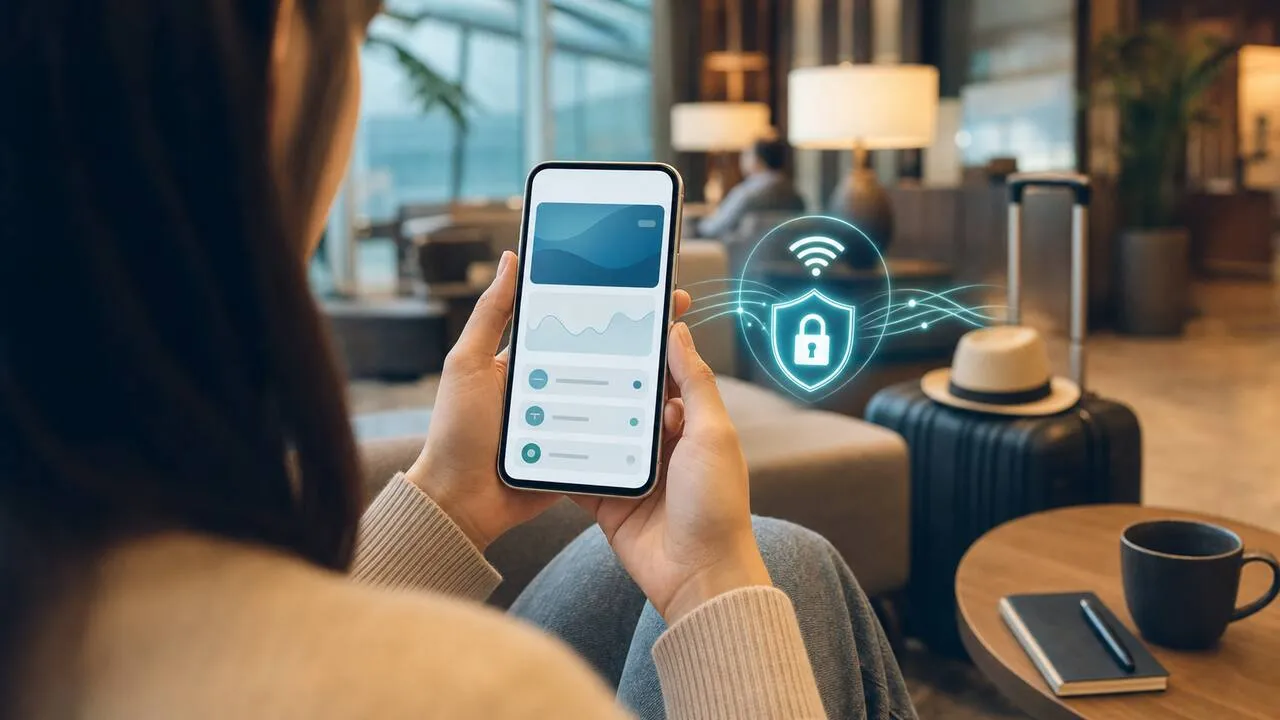
Logging into your bank from another country is generally safe — as long as you use your bank’s official app or website over a connection you control, and you’ve prepared for the bank’s own security to treat a foreign login as suspicious. The genuine risks abroad aren’t exotic hacks; they’re ordinary ones: an open hotel or café network where traffic can be watched, a fake “Free Wi-Fi” hotspot, and a fraud system that freezes your card the moment it sees a login from a country you’ve never used before. Sort those three out and overseas banking is no riskier than banking at home.
What’s actually risky about banking abroad — and what isn’t
The encryption between your banking app and the bank is the same whether you’re at home or in a hotel in Bangkok. That part travels well. What changes abroad is everything around it: the networks you connect through, and the assumptions your bank makes about where you are.
So the risk isn’t usually someone “breaking the bank’s encryption.” It’s the gaps: typing your password on a network a stranger controls, tapping a phishing link while you’re rushed in an airport, or losing access entirely because your bank’s fraud system decided a login from overseas must be theft. Most of this is preventable with a little setup, not luck.
The public Wi-Fi problem: open networks and fake hotspots
Hotels, airports, and cafés almost always run open Wi-Fi with no real isolation between guests. On a network like that, an attacker on the same connection can attempt to intercept unencrypted traffic or push you toward a fake login page. Banking apps use strong encryption, so the login itself is usually protected — but the surrounding pages, redirects, and any non-banking account you log into on the same network are not equally safe.
The sharper threat is the lookalike hotspot: a network named “Hotel_Guest_WiFi” or “Airport_Free” set up by someone in the lobby to capture whatever you type. If you connect to it and log in, the encryption doesn’t help, because you handed your session to the attacker’s network on purpose. Before you bank on any public network, run through our public Wi-Fi safety checklist — and be especially wary in the exact places people travel through, which we cover in hotel and airport Wi-Fi safety.
The overlooked risk: your own bank locking you out
The problem most travelers hit isn’t an attacker at all — it’s their bank. Fraud systems flag a sudden login or card swipe from a new country as likely theft, and the “protection” is to freeze the account or block the transaction. You find out at the worst moment: at a hotel checkout, or when you’re trying to move money and the app simply refuses.
Two things cause this: a login from an IP address in an unfamiliar country, and a one-time passcode that never arrives because it was sent to a phone number that doesn’t work on roaming. Both are fixable before you leave, and both are about access, not hackers.
Before you fly: set up access so you don’t get locked out
A few minutes of preparation prevents most overseas banking headaches:
- Tell your bank you’re travelling. Many banks let you file travel dates in the app so a foreign login or card use doesn’t trigger an automatic freeze.
- Make sure you can receive verification codes. If your bank sends one-time passcodes by SMS, confirm that number works on roaming, or switch to an authenticator app or in-app approval that works over data.
- Install and test the official app before you go. Download it from the official store at home, log in once, and confirm it works — never go hunting for “your bank’s app” on a hotel network.
- Note your bank’s real support number. Save it from the back of your card or the official site, so if you do get locked out you’re not searching for it on a public network.
- Turn on every account-recovery option while you still have your home connection and a working phone number.
A broader pre-trip routine — apps, backups, and connection set up the day before — is in our VPN travel checklist.
On the day: how to log in safely overseas
When you actually need to check a balance or move money abroad, the habits matter more than the location:
- Use the official app, not a link from an email or a search result you tapped in a hurry.
- Prefer mobile data over open Wi-Fi for anything financial — a roaming or local SIM connection isn’t shared with strangers the way a café network is.
- If you must use public Wi-Fi, encrypt the whole connection first so nothing on that network can read it.
- Log out fully when you’re done, rather than leaving a session open on a device that might be lost or shoulder-surfed.
- Never approve a login request or passcode you didn’t trigger yourself — that’s someone else trying to get in.
Where a VPN helps with overseas banking — and where it doesn’t
On untrusted networks, a VPN does one useful, specific thing: it encrypts your entire connection so an open hotel or café network can’t read or tamper with your traffic, even the non-banking pages a banking app alone doesn’t protect. That closes the public-Wi-Fi gap that worries most travelers.
A VPN can also reduce the “locked out from a strange country” problem. Connect through a server in your home region and your bank sees a login from a familiar location rather than a random foreign IP — Lubi VPN’s network is optimised for Asia, so users from Taiwan, Japan, and Korea can reach a nearby home-region server without the speed penalty of routing across the world. The service excludes page content, complete URLs, and payload data from retention; its Privacy Policy explains that limited connection metadata is ordinarily kept for no more than 90 days. One subscription covers your phone and laptop together, and there is a 30-day refund if it does not fit your trip.
What a VPN does not do is just as important: it won’t stop you from typing your password into a phishing page, it won’t rescue a weak or reused password, and it can’t approve a verification code for you. A VPN protects the connection; you still protect the account. For more on that boundary, common VPN mistakes beginners make covers what a VPN is and isn’t built to do.
If something looks wrong
If your banking app suddenly logs you out, asks you to “re-verify” through an unfamiliar link, or you see a login alert you didn’t trigger, stop. Don’t follow links in the alert — open the official app directly, or call the support number you saved before the trip. Change your password from a connection you trust, not the public one you were just on. Caught early, an overseas banking scare is almost always just your bank being cautious — and a little preparation keeps it that way.