
Lubi VPN Plans Explained: Standard, Pro, or ProMax?
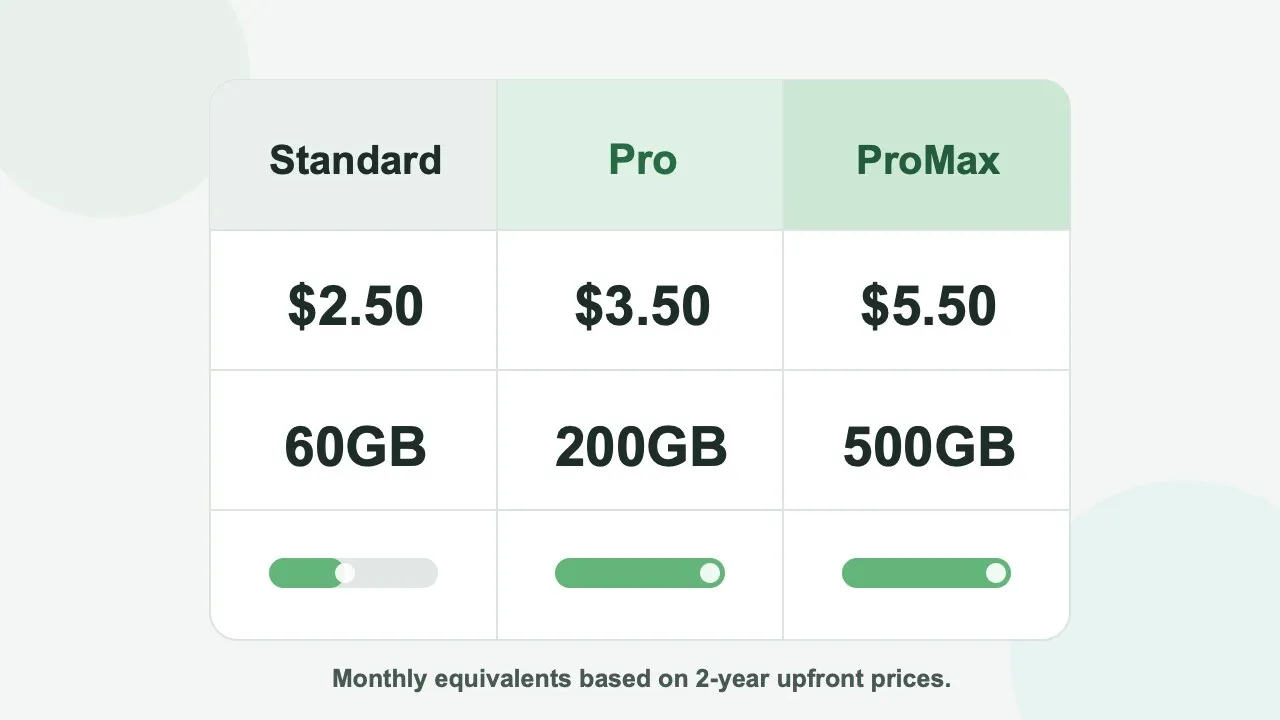
Choose Lubi VPN Standard for light everyday browsing, Pro when you need every server location with a balanced allowance, and ProMax when high-data activity across your devices routinely exceeds Pro’s capacity. The plans differ mainly in monthly high-speed data and server access; the largest plan is not automatically the right plan for everyone.
The three plans at a glance
| Plan | Prices by billing period | Monthly high-speed data | Server access |
|---|---|---|---|
| Standard | 2-year monthly equivalent $2.50 ($59.99 prepaid); yearly monthly equivalent $3.00 ($35.99 prepaid); monthly $3.99 | 60GB | Selected server locations |
| Pro | 2-year monthly equivalent $3.50 ($83.99 prepaid); yearly monthly equivalent $5.00 ($59.99 prepaid); monthly $7.99 | 200GB | All server locations |
| ProMax | 2-year monthly equivalent $5.50 ($131.99 prepaid); yearly monthly equivalent $7.50 ($89.99 prepaid); monthly $13.99 | 500GB | All server locations |
Taiwan server locations are included only with Pro and ProMax. When a plan’s high-speed allowance is exhausted, Lubi VPN provides reduced-speed backup servers instead of cutting the connection off completely.
All three plans come with a 30-day money-back guarantee and do not renew automatically. The yearly and two-year tiers are paid in full for their stated periods, not charged month by month; renewal remains a manual choice.
Standard is for a predictable, lighter routine
Standard fits a person who mainly uses a VPN for browsing, messaging, email, and occasional public Wi-Fi sessions. Its 60GB monthly high-speed allowance can be comfortable when large downloads and long high-resolution video sessions are not part of the routine.
The important trade-off is server choice. Standard offers selected server locations and does not include Taiwan. That can be fine when the available locations already suit your normal route. If a particular location is necessary, check access before treating the lower price as the deciding factor.
Do not estimate usage from screen time alone. Reading news for an hour and watching high-resolution video for an hour can consume very different amounts of data. A short personal inventory is more useful: note which devices use the subscription, how often they stream or download, and whether they move between public networks. The multi-device setup guide explains why one subscription should be assessed across the whole device library rather than one phone at a time.
Pro is the balanced middle, not a compromise plan
Pro raises the monthly high-speed allowance to 200GB and opens all server locations, including Taiwan. It suits people who use a VPN frequently, stream regularly, work from different networks, or simply need broader location choice without moving directly to the largest allowance.
This is also the clearest option when Standard’s server range is the limitation but 500GB would be excessive. Location choice and data volume solve different problems: one determines where you can connect, while the other determines how much high-speed traffic the subscription can carry during the month. The server-location guide can help separate latency needs from assumptions about the map.
ProMax is for measured high-data demand
ProMax includes 500GB of high-speed data per month and the same full server-location range as Pro. Its advantage is capacity, not an extra list of locations beyond Pro.
The plan makes sense when repeated high-data activity is normal: several personal devices share the subscription, large transfers happen often, or streaming and remote work consume enough data that 200GB would leave little margin. It is less convincing when “more” is only a precaution and actual use stays light.
A practical check is to review data use over a normal month on the operating systems and services you already use. Measure an ordinary month, not a holiday spike or one unusually quiet week. If the total sits comfortably below a plan’s allowance, a larger tier will not make light browsing inherently safer or faster.
Price does not describe the entire fit
Lubi VPN’s tiered allowances reflect a pricing trade-off. Most everyday use stays well below extreme data demand. Pricing everyone for unlimited capacity would spread the cost of that heavy use across lighter users too. Separate allowances let ordinary users pay for a smaller capacity tier while people who need more data can choose and pay for it. The trade-off is a high-speed limit to keep in mind, rather than one allowance for everyone.
A lower monthly price is valuable only when the plan includes the server access and capacity you need. A higher price is worthwhile only when the added allowance is likely to be used. This is why the broader question of cheap versus premium VPNs should not be reduced to one number: reliability, product rules, and fit matter alongside the fee.
The three Lubi VPN plans share several practical policies. One subscription can be used on all your devices when you sign in with the email entered at checkout. Supported systems are iOS 15 or later, Android 7 or later, macOS 12 Monterey or later, and 64-bit Windows 10 or later. None of that means every household has the same traffic pattern, so count the devices that actually use high-data activities rather than the devices merely capable of installing the app.
A simple decision sequence
Start with server access. If selected locations are enough, continue comparing Standard’s 60GB allowance with your measured use. If you need all locations or Taiwan, compare Pro at 200GB with ProMax at 500GB.
Then leave room for ordinary variation. A plan that is exceeded every month is too small; a plan whose allowance remains almost untouched may be larger than necessary. Remember that exceeding the high-speed allowance leads to reduced-speed backup servers, not an abrupt disconnection.
Finally, review the current payment period and terms on the localized pricing page before making a decision. Product fit is straightforward when the question is phrased correctly: first choose the server range you require, then choose the smallest high-speed allowance that comfortably covers a normal month.
You do not need a perfect usage estimate before choosing. Changing plan tiers converts the remaining paid subscription value into usable days based on the old and new plans’ pricing. A higher-priced tier leaves fewer days; a lower-priced tier leaves more. This is an equivalent-value conversion, not a deduction of days. After changing, you cannot change again within 7 days, and insufficient remaining data or days can prevent a change. Switching changes the plan tier, not the billing-period length you purchased.